How to Safely Purchase Established and Vintage Facebook Profiles for Effective Social Media Marketing
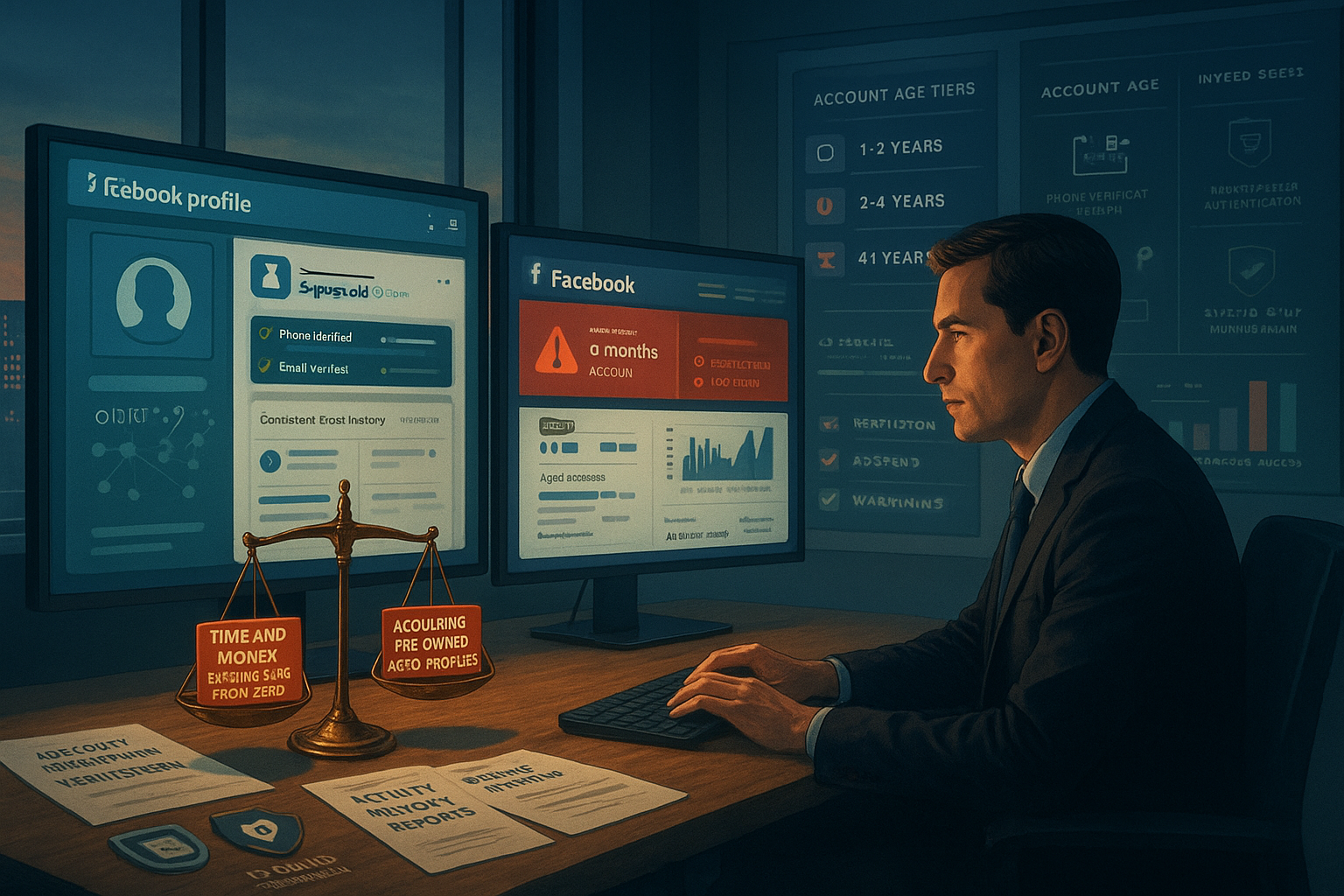
A Facebook account created yesterday and one created six years ago are not the same tool - not even close. The platform's internal systems treat them differently, advertisers experience this gap daily, and the consequences are measurable: restricted ad accounts, lower organic distribution, and constant friction during campaign setup. For marketers, agencies, and growth-focused entrepreneurs, this reality has driven a clear strategic response: working with accounts that already carry platform trust rather than spending months trying to build it from scratch.
The market for pre-owned, aged, and legacy Facebook profiles has matured considerably. Professionals who want to obtain established Facebook profiles with genuine history now have access to structured marketplaces designed specifically for this purpose. Resources that let you buy old facebook accounts with documented creation dates, verified credentials, and real activity histories have moved from obscure corners of the internet to legitimate platforms serving serious marketing operations.
What this article provides is a practical, honest guide to the entire process - from understanding why account age matters to evaluating sellers, completing a secure purchase, stabilizing an account after transfer, and deploying it effectively for marketing. Every major risk is addressed, and every stage of the process is broken down so you can make informed decisions rather than expensive mistakes.
Why Aged and Established Facebook Profiles Hold Marketing Value
Facebook's platform does not treat all accounts equally, and this is not accidental. The algorithm assigns varying levels of trust to profiles based on behavioral history, account age, interaction patterns, and consistency of use over time. An account that has existed for several years, maintained regular activity, accumulated genuine connections, and never triggered policy violations carries a fundamentally different status than one created last week.
This trust differential has direct consequences for marketing performance. Aged accounts typically face fewer restrictions when creating or linking to ad accounts. They encounter less friction during the ad review process, experience fewer unexplained spending caps, and are less likely to be flagged for identity verification mid-campaign. For a marketer running time-sensitive campaigns, the difference between a trusted account and a fresh one can mean the difference between a campaign launching on schedule and spending days in review limbo.
Organic reach follows similar logic. Facebook's distribution system deprioritizes content shared through new, low-activity accounts. A profile with years of engagement history and an established friend network distributes content more effectively, because the platform has more data confirming that the account represents a real, active participant in its ecosystem.
Beyond algorithmic advantages, there is a social proof dimension. Profiles with an existing friend network, consistent post history, and visible activity history look credible to other users. When such a profile manages a page, moderates a group, or engages in community spaces, it carries weight that a blank profile simply cannot replicate quickly.
| Account Type | Typical Ad Spend Access | Organic Reach Potential | Risk of Early Restriction | Time to Full Marketing Utility |
|---|---|---|---|---|
| New account (0-3 months) | Severely limited, often capped | Low - minimal trust signals | High | Several months minimum |
| Mid-age account (1-2 years) | Moderate, may increase over time | Moderate with consistent activity | Medium | Weeks to months depending on history |
| Established account (3+ years) | Higher, with fewer imposed caps | Strong, especially with active network | Low with careful management | Near-immediate with proper warming |
The marketing case for choosing to purchase aged Facebook profiles rather than building new ones rests on a simple calculation: time and money spent building account trust from zero often exceeds the cost of acquiring an account that already has it.
Understanding the Market: Types of Vintage Facebook Profiles Available
Deciding to acquire vintage social media accounts is only the first step. The market offers a wide range of profile types, and each comes with a different value proposition, risk profile, and practical use case. Understanding these distinctions before entering a marketplace prevents mismatched purchases and wasted investment.
Profile Age and Activity Levels
Account age alone does not define value. A profile created five years ago that has been dormant for four of those years carries far less marketing utility than one that has maintained regular, authentic-looking activity throughout its life. The reason is straightforward: Facebook's trust signals are built through consistent behavioral data, not simply through the passage of time.
When evaluating an account's age category, consider what that age represents in terms of actual activity. A well-maintained two-year-old account with regular posts, interactions, and connections can outperform a dormant five-year-old profile in terms of platform trust and advertising capability. Reputable sellers typically provide documentation showing both creation date and activity history, and buyers should insist on both data points rather than treating age as the only metric.
In practice, accounts are commonly classified by age tiers: one to two years, two to four years, and four or more years. Older accounts with sustained activity command higher prices and offer greater stability for intensive marketing use. Younger accounts in the one-to-two-year range may be sufficient for lighter use cases such as page administration or group moderation where heavy ad spend is not the primary goal.
Account Types: Personal Profiles vs. Business-Linked Accounts
The distinction between a standalone personal profile and one already connected to a Facebook Business Manager is commercially significant. Personal profiles are used as the foundation for creating pages, running ad accounts, and managing groups - but the profile itself does not run ads. Business-linked accounts, by contrast, come with an existing Business Manager structure, sometimes including ad account history that can accelerate campaign capability from day one.
For marketers whose primary goal is ad campaign management, a profile already linked to an established Business Manager with clean ad account history is considerably more valuable - and more expensive. For those who need profiles primarily for page administration, community management, or content distribution, a clean personal profile with strong age and activity history is typically sufficient and more cost-effective.
One important caution: accounts that come with an existing Business Manager may also carry prior ad account restrictions or payment issues that are not immediately visible. Always request the full Business Manager history and verify the ad account status before completing a purchase of this type.
Verified vs. Non-Verified Accounts
Verification status determines how securely you can control an account after transfer and how resistant it will be to Facebook's automated security reviews. There are three primary verification tiers worth understanding.
Phone-verified accounts are tied to a mobile number. After purchase, the ability to transfer control of that number - or replace it with your own - is critical. If the original phone number remains attached and you cannot access it, you are vulnerable to losing account access the moment Facebook sends an authentication code to that number.
Email-verified accounts offer a slightly more manageable transfer path, since email access can typically be transferred or replaced more cleanly than a phone number. Two-factor authentication setups add another layer of complexity: they offer stronger security but require the buyer to fully inherit or reset the authentication method before the original owner's access is closed out.
For serious marketing use, the ideal purchase includes full transfer of both the primary email address and the phone number associated with the account, along with a clean handover of any two-factor authentication setup. Accounts where only a password is transferred, without control of the attached recovery credentials, represent a meaningful ongoing security risk.
| Account Category | Primary Marketing Use | Verification Level | Relative Price Range | Key Consideration |
|---|---|---|---|---|
| Dormant personal profile (aged) | Page admin, basic community management | Email only | Lower | Activity history may be thin |
| Active personal profile (aged) | Organic reach, page admin, ad account setup | Email + phone | Moderate | Best balance of cost and utility |
| Business Manager-linked profile | Ad campaigns, full business operations | Email + phone + 2FA | Higher | Verify ad account history before purchase |
How to Evaluate Sellers and Identify Legitimate Sources
The decision to buy pre-owned Facebook IDs becomes financially and operationally risky the moment a buyer engages with an unreliable seller. The market includes professional, structured marketplaces operating with genuine quality standards - and it also includes informal operators who deliver accounts that fail within hours or never existed as described. Knowing how to tell them apart is not a minor skill; it is the most important practical competency in this entire process.
Key Indicators of a Reputable Seller
Legitimate sellers and marketplaces share a recognizable set of characteristics. They provide documentation of account history before the transaction completes, not after. This documentation includes the account creation date, a summary of past activity, and verification credentials that will be transferred to the buyer.
Reputable sellers also maintain a visible, verifiable review system - not a wall of five-star ratings with no detail, but structured feedback that describes transaction specifics, account performance after delivery, and the seller's responsiveness when issues arise. The absence of detailed, transaction-specific reviews is itself a warning sign.
Clear replacement and refund policies, published before purchase, are a non-negotiable marker of professionalism. A seller who cannot articulate what happens if an account is restricted or banned within 24 hours of delivery is not a seller worth trusting with a significant purchase. Responsive support - available through a clear contact channel before money changes hands - further distinguishes professional operations from casual resellers.
Red Flags and Warning Signs to Avoid
The following patterns consistently appear in problematic transactions and should prompt a buyer to walk away regardless of how attractive the account or the price appears.
- No documented account history provided prior to payment
- Prices significantly below the observable market average with no clear explanation
- No replacement or refund guarantee of any kind
- Seller declines to confirm account age or activity history with evidence
- Marketplace has no detailed buyer reviews or displays only generic, unverifiable praise
- Payment methods that offer zero buyer protection or dispute resolution
- Credentials delivered are incomplete - password only, with no email or phone transfer
- Seller pressure to complete the transaction quickly without time for verification
Unusually low prices deserve particular scrutiny. An account with genuine age, verified credentials, and solid activity history represents a real asset, and its price reflects that. When pricing falls far below what comparable accounts cost elsewhere, the most likely explanation is that the account does not actually have the history being claimed, or that it has existing restrictions the seller is not disclosing.
Evaluating Account Quality Before Purchase
Before completing any purchase, a structured verification process protects the buyer from common delivery failures. The following checklist covers the essential points to confirm, in order of priority.
- Confirm the account creation date through seller-provided documentation or a direct account preview
- Review the friend list for volume and profile authenticity - real accounts with their own history and activity
- Examine post and activity history for consistent, human-pattern behavior over time
- Verify that full email address access will be transferred, not just the login password
- Confirm that the phone number attached to the account will also be transferred or replaced with your own
- Request confirmation that the account has no existing policy violations, ad restrictions, or active appeals
- If the account has prior ad account activity, request the ad account status and spending history
- Obtain the replacement policy in writing before any payment is made
Skipping even one of these steps introduces risk that experienced buyers consistently cite as the source of post-purchase problems. The process may feel thorough for a digital transaction, but the stakes - both financial and operational - justify the diligence.
Legal, Ethical, and Platform Policy Considerations
Any honest discussion of this market must address the policy environment directly. Facebook's Terms of Service state that accounts are non-transferable and that users may not share login credentials or sell access to their profiles. This is a platform policy position, not a law in most jurisdictions - but the distinction matters, and so do its practical implications.
From a legal standpoint, buying and selling social media accounts is not a criminal act in the vast majority of countries. There is no broadly applicable law that prohibits the transaction itself. The relevant risk is entirely platform-side: if Facebook identifies that an account has changed hands, it may restrict or permanently disable the account. The platform enforces this primarily through behavioral and technical signals rather than through legal action against buyers or sellers.
Facebook's detection mechanisms for account transfers rely primarily on sudden changes in device fingerprint, IP address geography, login patterns, and behavioral sequences. An account that logged in consistently from one city for years and then suddenly appears active from a different country on an unfamiliar device is a pattern the platform's automated systems are designed to notice.
This is why the concept of account warming - covered in detail in the next section - is not optional. It is the primary mitigation tool buyers have for reducing detection risk after a transfer. Beyond warming, several practical measures reduce exposure:
- Use a consistent device and IP environment for the account from the moment of transfer
- Avoid making multiple large changes to the account simultaneously after receiving access
- Do not immediately connect the account to advertising infrastructure without a stabilization period
- Keep activity patterns realistic - gradual changes rather than sudden, high-volume actions
- Understand that Facebook's review processes can be triggered at any time, and have a contingency plan
On the ethical dimension: using purchased accounts to impersonate individuals, spread misinformation, manipulate public discourse, or conduct fraudulent advertising campaigns is harmful and, in many contexts, legally actionable regardless of the account's origin. Legitimate marketing use - running campaigns, managing brand pages, building communities - falls into a different category entirely. The ethical line is defined by what the account is used for, not merely by how it was acquired.
Buyers should also be aware that Facebook's enforcement landscape evolves. Policy changes, algorithmic updates, and enforcement priorities shift over time. An account that operates without issue today may face new scrutiny if Facebook modifies how it identifies transferred profiles. Maintaining account health and avoiding policy-triggering behavior remains the best long-term protection available.
Step-by-Step Process for Safely Purchasing and Transferring an Account
Understanding the market and identifying quality accounts is necessary preparation. The actual mechanics of completing a secure purchase and transferring an account safely require their own attention. Each stage in the process carries specific risks that practical steps can meaningfully reduce.
Choosing the Right Platform or Marketplace
Not all marketplaces that offer to help you obtain established Facebook profiles operate at the same standard. Before registering on any platform, assess it against a clear set of criteria.
A trustworthy marketplace maintains a publicly visible catalog with detailed account descriptions - including age, activity level, verification status, and category. It operates an escrow or protected transaction system, meaning funds are held until the buyer confirms receipt and access. It publishes its replacement and dispute policy clearly, without requiring you to contact support to find out what happens if something goes wrong.
Customer support responsiveness is a reliable indicator of platform quality. Send a pre-purchase question and evaluate how quickly and specifically it is answered. A vague, delayed, or automated response to a straightforward question about account specifications is a useful early signal about how disputes will be handled after a transaction.
Price comparison across platforms is also valuable - not to find the cheapest option, but to understand what a realistic price range looks like for the account type you need. Marketplaces with prices far below the observable range warrant significantly more scrutiny before any money is committed.
Completing the Purchase Securely
Once a suitable account and a reliable marketplace have been identified, the transaction itself requires careful handling to avoid common points of failure.
- Select the specific account based on verified age, activity history, and verification credentials
- Request complete account details - creation date, friend count, verification type, and any ad account history - before payment
- Use a payment method that offers buyer protection or dispute resolution; avoid irreversible payment channels for first transactions with a new seller
- Confirm the replacement policy applies to your purchase and obtain this confirmation in writing or through the platform's documented terms
- Complete payment and receive login credentials, associated email access, and phone number transfer instructions
- Immediately log in to verify account access is functional before signaling completion of the transaction
- Change the account password as the first action after confirming access
- Transfer the associated email address to one under your sole control
- Set up two-factor authentication using your own phone number or authentication application
This credential transfer sequence - password, email, phone, two-factor authentication - should be completed in full before the transaction is considered closed. Any account where the previous owner retains access to one of these recovery paths represents an ongoing access vulnerability.
Account Warming: Stabilizing the Account After Transfer
Account warming is the process of gradually reintroducing normal-looking activity to an account after ownership transfer, with the explicit goal of avoiding patterns that Facebook's systems associate with account compromise or suspicious ownership change. It is the single most important operational step between purchase and active marketing use.
The fundamental principle is restraint. Every major action taken on an account immediately after transfer - running ads, creating pages, changing profile details, mass-connecting with new users - represents a behavioral signal that deviates from whatever pattern the account previously exhibited. Each deviation increases the probability of triggering a security review.
A practical warming timeline works as follows:
- Days 1-3: Log in once or twice daily from a consistent device and IP address. Make no changes to the profile. Do not initiate any friend requests or post any content.
- Days 4-7: Begin minimal activity - a single profile update, one or two post interactions (likes or comments on existing content). Keep all actions brief and spaced out.
- Week 2: Introduce light content posting and a small number of friend interactions. Continue using the same device and network environment.
- Weeks 3-4: Create or connect to a Facebook Page if needed. Add a modest amount of profile information. Avoid high-volume actions.
- Month 2 onward: Begin connecting the account to Business Manager infrastructure and, if applicable, configuring ad accounts. Start with conservative spend levels and increase gradually.
The exact timeline varies based on account age, prior activity level, and intended use. Accounts with rich, consistent history can often be stabilized more quickly than those with sparse or erratic prior activity. The goal is always to let the behavioral pattern normalize before applying marketing pressure to the account.
Practical Applications: How to Use Purchased Profiles for Social Media Marketing
A safely transferred and properly warmed account is now an operational marketing asset. The question of how to deploy it effectively depends on the specific objective - advertising, community management, or organic brand building each require a different approach and benefit from the account's aged status in distinct ways.
Running Facebook Ad Campaigns with Aged Accounts
Advertising is the use case that most directly benefits from account age. Established accounts linked to Business Manager infrastructure face fewer automated holds during ad review, encounter fewer identity verification requests mid-campaign, and generally have access to higher spending tiers than fresh accounts in comparable categories.
When connecting a purchased account to a Business Manager for advertising purposes, do so only after the warming period is complete. The connection itself is a significant behavioral event, and making it too soon after transfer increases review risk. Once connected, start with modest campaign budgets and allow the ad account to build its own history before scaling spend aggressively.
Keep the account's login environment consistent. Running an ad account from one device and network while managing the profile from another introduces the kind of behavioral inconsistency that can prompt Facebook to flag the account for review. Consistent tooling is not a minor operational detail - it directly affects account longevity.
Managing Pages, Groups, and Communities
Facebook applies scrutiny to pages and groups based in part on the administrative accounts attached to them. A page managed by an established, active profile with years of history is treated differently than one where the sole admin is a profile created last month. This affects both the page's own reach and its vulnerability to removal during Facebook's periodic authenticity reviews.
For group moderation, the same principle applies. An established profile serving as a group admin lends structural credibility to the community and reduces the chance of the group being flagged or removed during automated compliance reviews. When purchasing legacy Facebook accounts specifically for page or group management, prioritize profiles with genuine activity history over those that are merely old but dormant.
Multi-admin arrangements - where a purchased established profile serves as one of several admins - distribute risk and reduce the operational impact if any single account faces a restriction. This is standard practice among marketers managing multiple pages or high-membership groups.
Building Brand Presence and Organic Reach
An aged profile with an existing network of real connections is a distribution asset. Content shared through such a profile reaches a broader audience organically than the same content shared through a new account with no established connections. For brands building an initial Facebook presence, this reach advantage can significantly accelerate early audience development.
The most effective organic strategies using established profiles treat the account as a genuine participant in relevant communities rather than a broadcast channel. Sharing useful content, engaging with others' posts, and contributing to group discussions in ways that reflect the account's apparent interests and history produces sustainable reach without attracting the kind of automated scrutiny that purely promotional behavior can trigger.
| Use Case | Why an Aged Account Helps | Key Actions to Take | Expected Outcome |
|---|---|---|---|
| Ad campaign management | Higher trust reduces ad holds and spend restrictions | Connect to Business Manager post-warming; start conservatively | Faster campaign approval, greater ad account stability |
| Page administration | Established admin profile reduces page vulnerability | Add as admin after warming; use as primary or co-admin | Increased page credibility and reduced review risk |
| Group moderation | Aged moderator accounts trigger fewer automated flags | Assign moderation roles gradually after stabilization | More stable group operation and member trust |
| Organic brand presence | Existing network amplifies content distribution | Engage authentically in communities; share gradually | Faster initial audience growth and content reach |
Questions and Answers
Can a purchased Facebook account be permanently banned, and what recourse exists?
Yes, any Facebook account - purchased or otherwise - can be permanently disabled if it violates platform policies or triggers Facebook's security systems. Recourse options include submitting a formal appeal through Facebook's help center, which has a limited but non-zero success rate for accounts disabled without a clear prior violation. The more reliable recourse is purchasing from a marketplace that offers a replacement guarantee and pursuing that route if the account fails shortly after delivery.
How long does the account warming process typically take before an account is ready for active ad use?
For most aged accounts with consistent prior activity, a warming period of four to six weeks before connecting to advertising infrastructure is a reasonable target. Accounts with richer, more recent activity histories may stabilize faster, while dormant accounts transferred after years of inactivity may need closer to two months of gradual reactivation before being reliable for ad campaigns.
What should I do if I receive an account that does not match the seller's description?
Document the discrepancy immediately - take screenshots of the account details and compare them against the seller's listed specifications. Contact the seller or marketplace support with this documentation and invoke the replacement or refund policy. If the transaction was completed through a platform with escrow or buyer protection, initiate a dispute before releasing payment. For this reason, never confirm transaction completion before fully verifying that the delivered account matches what was purchased.
Is it safer to purchase an account where the original owner closed access, or one where they retain partial access during a transition period?
Full and immediate transfer of all credentials - including email, phone number, and two-factor authentication - is substantially safer than a transition arrangement where the original owner retains any access. Partial-access transitions create a window during which the original owner could initiate a recovery process, intentionally or otherwise, resulting in account loss for the buyer. Complete the full credential transfer before considering the transaction closed.
Does the device or network I use to access a purchased account affect its stability?
It has a direct effect. Facebook's security systems track login devices, browser fingerprints, and IP address geography. Accessing a purchased account from a location or device pattern dramatically different from the account's prior activity history increases the probability of a security checkpoint or temporary lock. Using a consistent device and network from the start of the warming period, and maintaining that consistency during active marketing use, materially reduces this risk.
Are there account types or age ranges that are better suited to beginners purchasing their first established profile?
For buyers new to this process, an active personal profile aged between two and four years, with phone and email verification both included in the transfer, represents a practical starting point. This category offers a meaningful trust advantage over new accounts, carries a manageable price, and is straightforward to warm and deploy for page administration or moderate ad use. Business Manager-linked accounts with extensive ad history are better suited to buyers who already have experience managing transferred accounts and can assess the associated history accurately.